

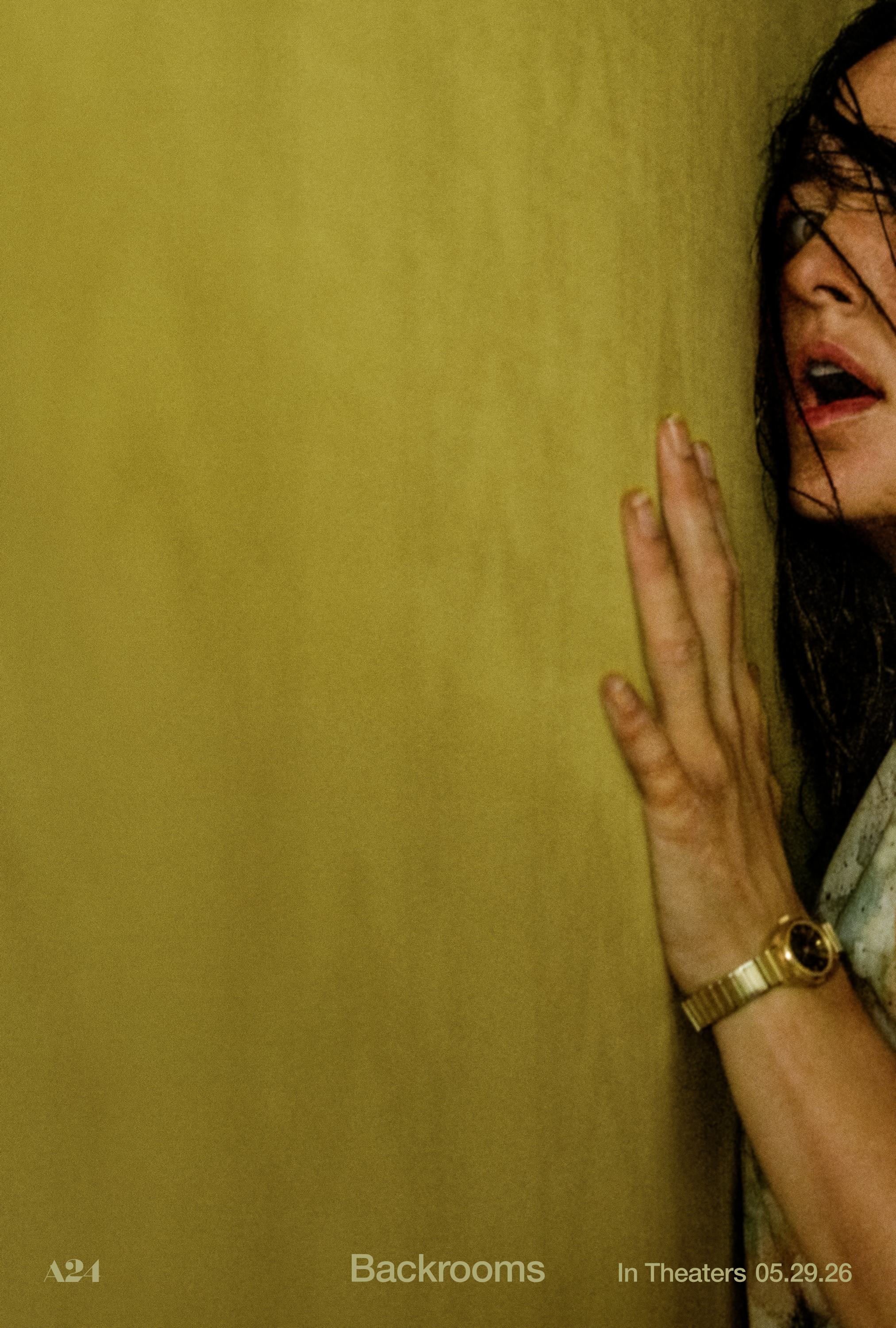
Content Note: This post discusses themes of trauma, dissociation, and the inner parts of ourselves that form in response to difficult experiences. It contains spoilers for the A24 film Backrooms (2026), directed by Kane Parsons. If you haven’t seen the film and want to go in fresh, bookmark this and come back.
I watched the movie Backrooms on vacation because a friend recommended it. I wasn’t at all expecting what happened next.
I keep seeing his face this morning in my mind.
Captain Clark — the monstrous, oversized creature that appears in one of the film’s final acts — is dressed in a pirate costume, walking on a wooden leg, his face twisted into something between rage and absolute misery. He had been surviving his whole life in that costume. It was what had gotten him through, not what his heart desired. And looking at him, I felt a sadness deep in my gut that had nothing to do with horror.
I recognized the look. I’d seen it in my own mirror.
The Film
*Claude Sonnet description of the film
Backrooms, directed by twenty-year-old Kane Parsons for A24, follows Clark — a furniture store owner played by Chiwetel Ejiofor — who discovers a portal in his store’s basement that opens into an endless labyrinth of liminal spaces. Vast, uncanny hallways. Rooms that almost make sense. Familiar enough to unsettle you, strange enough to trap you. Clark has recently separated from his wife, is quietly drowning in alcoholism, and has taken to sleeping at the store rather than face whatever his real life has become.
The Backrooms, for him, isn’t a horror. It’s a relief. A place where the ordinary demands of being a person can’t reach him.
His therapist Mary eventually follows him in. What happens next is where the film moves from a horror movie into something I can only call self-recognition.
Clark ties Mary to a chair in a kitchen suspended in this nowhere dimension and places his ex-wifes red hair on her head. He demands they continue their sessions. He wants validation. He wants someone to agree that his wife’s departure, his business failure, his unraveling — all of it — was something that happened to him. Mary refuses. She tells him the truth: that he shifted responsibility, again and again, to everyone around him. That that is why his wife left.
It’s one of the most surreal depictions of a therapy breakthrough I’ve seen in film — in the middle of a horror movie, in a fake kitchen, with a therapist tied to a chair at the kitchen table.
The moment Clark really understands what is happening and begins to set his therapist free is the exact moment when Captain Clark arrives. A monstrous, oversized version of the pirate persona he performed in commercials for his own store. A job he resented. A role he inhabited to survive. A role he blamed for much of his suffering. A mask that grew so large it became its own entity. And when Clark is finally on the threshold of change, it consumes him.
I felt my own heart sink.
The Part That Kept Me Alive
I understood what I was watching because I had lived a version of it.
There was a part of me that had grown enormous over the years. She seemed too big to overcome, too big to face. She was consuming me in order to survive — and for a long time I believed she would consume all of me. I made her my problem. If only I could defeat her, outrun her, overcome her.
But that’s not what transformed her.
Richard Rohr says trauma that isn’t transformed is transferred. What it actually took was a certain kind of death — an exposure, a loss of her power — because it had come down to her or me. And what finally reached her wasn’t a fight. It was an embrace. Because what she wanted, more than anything, was to be loved. To be heard. To know she had a role in my life, but not to run it.
Exposing her with my own therapist was the scariest thing I have ever done.
It felt like what happened to me in the ocean just the day before I watched this film.
I got caught in an undertow. That particular terror — the water pulling you sideways, the shore moving away — is not something you can think your way out of. My daughter who was further out in the ocean with a boogie board had figured it out before I did. She came alongside me and told me not to fight it. To anchor my feet into the sand, stand firm, and when the next wave came — let it propel me forward. We stood together and waited. We didn’t panic. And finally I reached the shore.
That’s so much of what surviving the overwhelm that comes with unresolved trauma requires- that comes like a powerful unexpected undertow. You go with it, not against it. You anchor. You wait. You let the wave move you forward instead of under.
Clark fought. He fought the part of himself that had only ever wanted to be seen and set down. But unfortunately it ate him alive.
The Faces in the Window
Clark’s ex-wife appears in the backrooms with a blurred face standing in the corner of the kitchen by the door. She’s not listening to him when he asks her to turn on the light. Maybe he can’t see her clearly — because he never really did. He takes her hair off and puts it on Mary because he needs someone to play the role she abandoned when she left him. I don’t think he’s grieving the real person she was. He’s grieving the story he needed to believe about her.
In November 2024, days before an election that terrified me, I dreamed of an old brick house — two stories, cracked walls, shattered windows. And through the broken glass, two figures with blurred faces looked out. I wrote about it then, not fully understanding what the dream was asking of me. I just knew the faces wanted something. I just knew the house was not at peace.
I’ve had these dreams for years. A large mansion with many rooms. Fuzzy faces pressing against the glass from outside, staring in at me, wanting something. Another time I was inside the mansion — it was perched above rocky ocean cliffs — and I was trying to climb back up, trying not to fall.
I didn’t know then what I know now. Those weren’t nightmares to escape. They were invitations.
The faces weren’t threatening me. They were waiting to be noticed.
I originally titled a memoir I’ve been working on The House Is Haunted. Watching this film I understood why that title spoke to me. Because that’s what it feels like — facing the trauma hidden inside our lives, moving through the liminal spaces where the unfinished things live, encountering faces that want only one thing from us.
To be seen. To be asked what they need.
We project onto others what we need or what we are trying to blame them for. Clark couldn’t bear to see his ex-wife’s real face. He needed her to stay blurred so he could keep writing his own story over her. The blurred face is what we do when we can’t let another person be fully themselves to us. We need them unclear so we can keep circling the same rooms with the same old stories that provide the illusion that we know what is actually happening.
The Hallway
Those strange spaces in our lives. The places that feel empty like there is nothing happening at all.
Stay there.
Slow down and don’t fight. Silence and stillness are places where we can rest and prepare for what is in the rooms ahead.
This is where bad religion happens. This is where consuming groups and social media and endless trauma recovery circles happen. Uncertainty rushes in and something comes to fill it — a carnival that offers dopamine rides and a sense of meaning and belonging in exchange for your energy. It keeps you riding so you never have to stand still in the hallway and face what’s actually there.
Social media is another room like this. A casino with bells and dings. It can feel like nourishment because there is real information there, real moments of being understood. But being understood feels like healing without always being healing. It’s the taste of nourishment, not the thing itself. Like eating a container of Pringles — no one can eat just one, and they taste good, and the salt is so much more exciting than a bland salad. But Pringles don’t build anything in you. And you can spend years in groups and on screens feeling like you’re doing the work when you’re actually just consuming the feeling of it.
Real metabolizing is slower. Quieter. More like the bland salad that actually builds something over time.
The settling is the metabolism. It’s finding harmony with yourself.
We complicate healing so much. But it isn’t complicated. It’s just slow. And we live in a world that has made slowness feel like failure.
Mary and the Wall
Mary didn’t rush through.
She tested it first — watched a fly enter, pressed her finger through, observed before she committed. There was something in her that simply knew. Not recklessness. Not rescue fantasy. Something quieter than both. A recognition. I have been in rooms like this before. I know what lives here.
That’s what it means to believe someone’s inner landscape — not because you’ve read about it or trained for it, but because you’ve walked those halls yourself.
Mary got curious. That’s the whole of her heroism.
I’ve been in those spaces too. And in February 2026 I wrote about a dream — a mansion on a cliff in Maine, buzzards circling, and a message I woke up hearing loud and clear:
Hold onto love when you only see monsters. Sometimes what looks like buzzards circling — like something tearing you to pieces — might be grief that’s necessary to grieve in order to see your true self.
That was Captain Clark before I ever saw this film. I’d been dreaming about him for years.
What the Young Man Knew
Kane Parsons is twenty years old. He didn’t sit down to write a film about trauma recovery or IFS parts work or liminal space theory. He sat down to work something out. And that’s exactly why it lands.
Trauma that is transformed transforms others. But it doesn’t happen most of the time with someone sitting down and saying I’m going to write this to change someone’s life. It happens when someone sits down and writes about their own healing.
Authentic self-examination has a frequency that bypasses all our defenses. We can feel it. Our nervous systems recognize it before our minds do. That’s why this film — made by a twenty-year-old with a camera and an internet legend and something true to say — cracked me open on a vacation afternoon in a way that years of seeking couldn’t.
He wasn’t performing insight. He was metabolizing something.
So was I, watching it.
The Point of Life?
I think the point of life might be this — to discover our own inner houses and no longer be afraid. So that we can offer the world the truest version of ourselves.
Not the performed version. Not the costume. Not the pirate on the wooden leg doing commercials for a furniture store he resented.
The real one. The one that only emerges when you stop fighting your own rooms.
Moving slowly and observing with curiosity about what is there. Doing the things that are necessary to do as we move along and not needing to have all the answers. They will come one room at a time. But when we don’t have the answers this is actually the most important time to stop and just observe.
Don’t fight it even when it feels like the boredom will pull you under into meaninglessness.
Undertow currents only go so far. Swim alongside when you feel like you are being pulled under and then when the pull stops you can enter into your life again. Or if you don’t know what to do — stand firm and call out for help.
Don’t fight because fighting can lead to exhaustion that can kill you.
Clark fought. We don’t have to.
Mary tested the wall first. She observed. She stayed curious. And she ended up exactly where she was supposed to be — in the liminal space, walking alongside someone who couldn’t find his own way out.
Some of us are built for that. Not because we’re rescuers. Because we’ve been in the rooms. We know what the atmosphere feels like in our bodies before we can even name it. We know how to anchor our feet in the sand and wait for the wave to pass.
That’s not a skill you can learn in a group or a course or a social media feed.
It’s something you earn — one room at a time, in the slow, unglamorous, necessary work of your own becoming.
If something here resonates and you’d like to explore what your own inner rooms are holding, I’d love to hear from you. Reach out at loriwilliamsliminalspace@gmail.com
When You Find Yourself in the Hallways and Scary Rooms
Here’s the STOP exercise for when you find yourself in the hallways and scary rooms…
If you’re in one of those empty in-between spaces right now and the urge to fill it is overwhelming, try this simple mindfulness practice:
S — Stop. Whatever you’re doing, just pause. Put down the phone. Close the tab. Step away from the noise.
T — Take a breath. One slow, deliberate breath. In through the nose, out through the mouth. Let your body register that you are safe in this moment.
O — Observe. Without judgment, notice what’s here. What do you feel in your body? What’s the quality of the silence? What are you actually afraid of if you stay still?
P — Proceed. With awareness. Not on autopilot. Not reaching for the next dopamine hit. Just — the next small thing, chosen consciously.
This is what Mary did at the wall. She stopped. She observed. She proceeded only when she was ready.
You can do the same.
A note on process: This post was developed in conversation with Claude, an AI assistant made by Anthropic. I came to the conversation with a film that had cracked something open in me, a collection of dreams spanning years, and a lot of unfinished thoughts. Claude helped me find the thread connecting them and shape what was already there into something I could share. The experiences, the images, the words — those are entirely mine. Claude helped me hear what I was already saying.