
One of the hardest parts of looking back on my time in church is facing how much didn’t make sense then and still can’t be reconciled today. Why did I so readily follow a dangerous man wherever he went? Why did it all feel like the right thing to do?
They say hindsight is 20/20, and to a degree it is. Today I recognize toxic behavior when I see it. I can spot circular reasoning when I hear it. But understanding what it was about me that made me believe it all—that’s still difficult to explain. Which is why I’ve spent so much time writing, breaking apart my story in small pieces, trying to understand where it all went wrong.
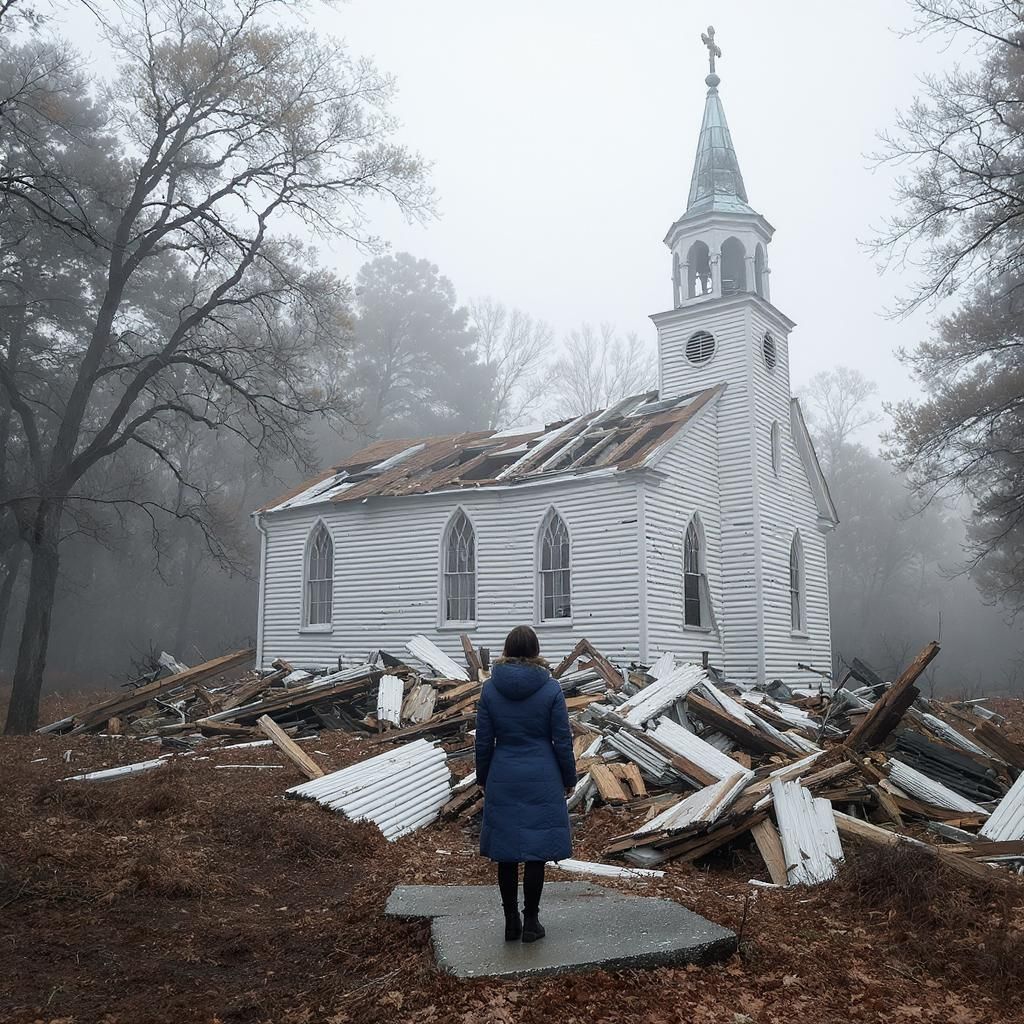
The last decade has been about tearing down termite-ridden walls of guilt and shame built by that belief system, clearing out space in my life. I’ve discovered God is infinitely bigger than I was taught to believe. I’m even dismantling the outer walls now. What’s left is a small foundation that somehow survived—my authentic self. I’m still getting to know her.
The more compassion I give her, the easier it becomes to understand what was missing in her life and why I believed a rigid belief system and a broken pastor could fill those gaps. Looking back, it’s clear there was so much missing—legitimate needs my parents didn’t know how to meet either. The need for safety, belonging, and identity. The hope that one day I would become the person I was meant to be.
The church seemed to offer all of those things in abundance. After a time, I believed I belonged, was safe, part of a family. I convinced myself I was the best version of myself. But what I’d actually been given was a set of rigid beliefs and structures that helped me feel safe. I was offered conditional love that felt like belonging when I followed their narrative for my life. I believed I was my best self when I allowed myself to be molded into who they said I should be.
Recently, listening to talks by creators and participants in The Eternal Song documentary, I heard an indigenous person speak about the reformatory schools their people were forced into—schools where vulnerable people depended on the system to meet so many needs, but were also taught to turn away from their authentic selves and become who they were expected to be. They said their people were taught to despise their lives before, to believe they were savages.
This hit home. I also learned to despise myself in that system, to believe my authentic self was bad. But I believed I was getting what I needed, which is why I stayed so long.
The Magic Thinking
I’ve been thinking about how many religious beliefs I used to be confident in no longer make sense in my life. I realize how much time and energy I burned worrying about things I assumed were left to chance—things I actually had a choice about, things I had responsibility for. But because I assumed so much of what happened was spiritual and out of my control, about all I thought I could control was determining whether something was sin or not.
Looking back, it feels like everything was either magical act of God or something I was doing against God. Every occurrence was either approval or disapproval. Emotions couldn’t be trusted unless they were guilt or shame—then you could rest assured there was sin somewhere, someone else’s or my own.
The only guidance I could have was reading my Bible daily and trusting what I read through the filter of my belief system. But it got confusing when things happened I didn’t understand. So I chalked that up to not being supposed to understand. I could rest assured everything had a reason and would work out for my good and God’s glory. Even if something bad happened as a result of something I hadn’t done intentionally, God would work that out for good too. You just couldn’t go wrong with a sovereign God and trusting his promises. All you had to do was trust, believe, and obey.
I’m amazed looking back at how much I was able to make things make sense. Over and over, I could fit a square peg into a round hole if I just kept trying. When I made it fit, my mind could find peace.
Even when I’d fallen into disobeying God, my pastor told me “our sins” actually made us more humble and wise, better able to relate to others. Remember Peter—he denied Jesus three times, then later Jesus told him that after he’d fallen, he’d have wisdom to strengthen his brothers. How many times did I listen to that rationalizing when nothing else made sense? That was why my pastor was so wise and able to help someone as messed up as me. Of course I believed it was my fault—it was always the woman’s fault. That made sense to someone raised by a man who sexually abused his daughter.
And about the abuse? Well, I’m happy to report that I reasoned in that system that it was part of God’s will too. He won’t put more on you than you can stand, they said. What doesn’t kill you makes you stronger. It was ordained. It’s how I became the super saint and the woman I am today. Now I really have a testimony. I needed to focus on that because otherwise, if I dwelled on mistakes and continued feeling guilty, that meant I wasn’t trusting God and would be trampling on the Son of God instead of accepting his gracious forgiveness.
It didn’t matter what it was—I always had an answer that lined up, something I could hold onto, though often something I had little control over. And it was all okay because I had grace. Grace meant there was always another chance, always understanding from God that if I goofed up it was sin, and as long as I prayed the prayer and started trusting again, all would be well.
But it worked until it didn’t.
When the System Collapsed
Until I found out my pastor had been grooming me to abuse me. When I learned that gut feeling I’d had early on really was there for a reason—it was telling me I wasn’t safe, not that I was sinful and bad and needed to just trust God.
It never ceases to amaze me how much I ignored my own intelligence by assuming that if I felt good, it meant I was pleasing God, and if I felt bad, I just needed to pray and ask forgiveness for whatever was wrong. It was usually me that was wrong, because if it was me, I could feel like I had some control.
It was that way when I was a child—as long as I kept my adoptive father happy, I could feel safer. Same with the pastor: if I kept him happy, I would be safe. Even when I messed up. Even when I “caused him to stumble.” I’d convinced myself I was in control when I had no control because I had absolutely no clue what was happening inside me and why.
But logically, I could keep going back to the Bible to find an answer, find relief, and it was always there if I didn’t stop looking.
I don’t have a problem with the Bible. It’s an amazing book full of hope and wisdom and evidence of how sometimes people really can’t see the forest for the trees or the Son of God standing right in front of them. The religious people of that time couldn’t understand why Jesus wouldn’t do what they asked, so they sent him to die on the cross. These days they worship that same Jesus but do the same damn thing as the people who put him on the cross.
They didn’t know what to do with the fact that Jesus wept either, that he empathized with Mary who had lost her brother because he loved Lazarus too. He knew what to do with his emotions—to feel them, be honest about them, and not be afraid to show them to others. But surely it was something in his eye because real men don’t cry, do they? Real men amass large amounts of wealth and send away all the people who don’t look like them.
The Jesus the religious people wanted would reject the Samaritan woman, the lepers and the drunks. And that scene where Satan offered to make him king over the earth—maybe that was wrong interpretation, because surely Jesus wants to be made king. It’s no wonder he was a disappointment to so many who hoped he would rule over earth and make his followers royalty.
But those same people have no problem making Jesus whatever they need him to be to get what they want, even if it doesn’t line up at all with who Jesus was. People believe it because we’re used to having a God we don’t understand. We’re only human and we just need to trust and stay away from certain sexual sins.
Breaking Free from Circular Reasoning
Does it sound like I’m cynical? I confess I am, especially when I listen to people who believe the same things I used to and make it a point to share just how strong their faith is. It’s so strong they don’t have to understand what’s happening because “everything happens for a reason.”
This circular reasoning will keep us going for a long time until we get to the end of a cliff. Maybe some people never get to that edge—they’re happy thinking that way until they get close to the end and still can’t talk about what really hurt them without telling you God has it all under control, even when you desperately need to hear they’re sorry for the pain they caused.
The circular reasoning sent me whirling into oblivion because I was going so fast there was nothing I could do to stop it. My mind couldn’t grab hold of anything that made sense anymore until finally I cried uncle.
When a therapist told me I had been abused by the pastor, I was standing at the precipice. There was nothing to do but jump and hit bottom and see the truth about how far I’d fallen following the wrong person into the ditch. Once I saw the truth, I couldn’t unsee it. There was no jumping back into the tornado because I saw how much damage could be done. Because I couldn’t get on board with the narrative they’d spun, I no longer fit in their story.
Today I recognize that others still in similar systems don’t understand. They still believe it’s their faith giving them what they need to keep going. Who am I to judge? I know how long I held on because I didn’t think there was anything else to hold onto.
But finally I found something else. I didn’t even have to have faith to believe in it, because so much of it has been learning to pay attention to what’s actually happening and why, recognizing that responsibility is the ability to respond and I actually do have some control.
Finding Real Ground
Now when I feel that bad feeling in the pit of my stomach, I look around for what might actually be wrong rather than automatically concluding it’s the Holy Spirit saying I messed up. I can be curious and compassionate toward myself and wait to see what the actual problem is. If I have control over whatever’s happening, I can work to bring about change. If it’s something I have no control over, I can pray and ask God to give the person who does have control some wisdom.
I don’t believe things happen nearly as much by chance as I used to. When someone is being harmed, it’s because someone chose to harm them, not because God has big plans to make the victim a super saint. I don’t minimize how much our pain is transformed into wisdom, but it’s not magical at all. It happens because we learn from our experiences, and if we suffer, most of us are decent human beings who don’t want others to go through the same thing. So we look at what hurt us, we learn, we share our knowledge, and we offer our empathy. Because that’s the way God made us.
Those mistakes definitely are our teachers and they do humble us, but it’s safe to say that if we do something we know will hurt someone else, we can’t justify it by saying our sin makes us humble. We need to look at why we became the kind of person who would hurt someone else. Why isn’t what we have enough that we think we need to take something belonging to someone else?
It’s hard work acknowledging that even victims, when they know better, can do better. I think for a long time I didn’t think I deserved to know better or do better, so I stayed stuck. But we all deserve to have things be better in our lives—to have burdens lifted, to love and be loved, to belong to each other. If this isn’t happening in our lives, something really is wrong.
When it’s about this person having the corner on truth and that person not, one set of folks going to hell and the other not, we’ve got a big problem because our creator told us the highest law was to love. Even if you don’t believe in God, I’m pretty sure most of us deep down long to love or be loved unless we’ve completely lost ourselves in the things Jesus said we could easily get lost in: money, power, and greed. But eventually those things will run out. What will be left?
Learning to Trust the Process
These are the thoughts running through my head for a long time, especially these days when people are rationalizing so much in the name of God and there’s so much misinformation it’s hard to watch. It feels overwhelming because it is, so I’m feeling what I feel and letting it pass like a tidal wave in the ocean that sometimes almost takes me under. But if I don’t fight it, I’ll come back to the surface to breathe and see the light again.
I don’t know what will happen, but I’ve decided God put me on this planet to do what I can and leave the rest up to my higher power. I believe each of us has a purpose, something no one else on this planet can do. It’s necessary and might not appear significant, but it is, because I still do believe God has a good plan we actually get to participate in. And one where we don’t have to check our brains at the door.
I heard someone say the earth is still being created every day—I really liked that. It lets me know we still have a choice, we still have some control, and we can take it a day at a time. We can learn from our mistakes and pass those lessons to others around us. If we’re focused on our own work, it’ll be easier not to look so closely at other people’s work and judge, because that isn’t our job either.
It’s really not that hard, even though it can feel incredibly difficult at times. It’s our unwillingness to look at the things we have control over and trust that we’re worthy and capable of exercising that control that can make it feel that way. It’s so important to remember we won’t do it all perfectly. The main thing is we keep trying and never give up, even when it gets dark and uncertain. Especially when it gets dark and uncertain.
Because as sure as our hearts desire something better, that desire is there for a reason. It matters. We just have to believe it does. That’s where real faith comes in.
If any of this resonates with you, please know you’re not alone in this journey—there are people who understand, who won’t try to fix you with easy answers, and who will sit with you in the mess until you find your own way through. Reach out to loriwilliamsliminalspace@gmail.com if you are looking for this kind of support.

 A Liminal Space
Leave a comment