

For the past four years, I’ve been immersed in learning about trauma responses—how to recognize them, understand them, and heal from them. It’s been transformative work. But here’s what I’m discovering: no matter how much we learn about trauma, we can still miss the patterns in our own lives that are quietly keeping us trapped in cycles of retraumatization.
I’ve realized it’s much easier to recognize destructive behaviors as trauma responses than it is to see the everyday things we do—the things that feel like exactly what we’re supposed to be doing to heal—as part of the problem.
For years, I wrote on this blog about the abuse I suffered in the church. Many of those posts are no longer publicly available. Because after reviewing them, I realized they shared a common thread – at times I was telling the same story over and over. The story that included details about how I was groomed, manipulated, and abused. And over focusing on some of these details was harmful to me.
I had no idea.
At the time, I genuinely believed that by reading others’ abuse stories and retelling my own, I was helping myself understand what happened to me and to heal. I still remember the searing pain I felt when people in my family or ministry circles said I was “identifying as a victim” when I retold my story in an effort to find understanding from them. Those words cut so deep. So I kept looking for someone who would listen and tell me they understood. The only ones who did were people who’d suffered similar losses or therapists who recognized the abuse for what it was.
Every time someone understood and validated my experience, it helped in the moment. But I’d also feel that same crushing powerlessness all over again. I never stopped to wonder if retelling the story was actually good for me—if maybe I was just retraumatizing myself with every telling.
Lately, I’ve been thinking about the difference between processing trauma and ruminating on it. Sometimes it’s hard to know which one you’re doing.
Here’s what I’ve discovered: when I write or talk about something, I am paying more attention to how I feel in my body. If I feel lighter and more hopeful—like I’ve gained some new insight or reached a conclusion about how to move forward—that’s processing.
But if I feel more disconnected, heavy, angry, and misunderstood? I’m probably stuck back in my trauma. And when this keeps happening to the point where it’s affecting my daily life and relationships, rumination is likely stealing my quality of life.
I don’t want to write another post that just focuses on the negative aspects of trauma. My goal is to help you understand that healing is possible and hope is real.
Sometimes it really is darkest just before the dawn. Sometimes grief falls so heavy it feels impossible to believe you’ll ever see light again. This is a necessary part of the process—I’m not minimizing that at all. There’s no right or wrong way to grieve.
But there is also a way to stay stuck. And removing the obstacles that keep us stuck is how we find our way back to hope and peace. It’s how we discover we actually have agency over our lives. That trauma doesn’t get the final word.
For me, rumination has been a major obstacle. Just recognizing its role in my life has already made me feel lighter – I have more control recognizing the pattern.
Rumination is a nervous system response to feeling powerless. And whenever we feel powerless, we’re retraumatizing ourselves. The key is awareness—recognizing the pattern and correcting it over time. Choosing to stay in the present moment rather than journey back into the darkness.
It’s a process. Be patient with yourself.
This became clearer to me today while listening to Dr. K on the HealthyGamer program. I realized something hopeful: I have more actual control over my life than I’ve been able to recognize. In all my attempts to figure out what went wrong and who to blame, I realized I’d been applying old conclusions to new situations. Those past circumstances don’t define my present reality. When I can focus on what’s actually happening now and see it clearly, I discover I have far more agency than I thought.
But here’s what’s so unsettling: I’m only just realizing this now. After all this time.
In trauma recovery spaces, there’s this idea that if someone stays stuck, they must be getting some kind of secondary benefit from their trauma or coping mechanisms. It’s a theory that’s meant to help, but it can feel so cold. Here’s what I think is more true: rumination connected me to compassion, empathy, and validation when I desperately needed those things. And honestly? I did need them. We all need to feel seen and understood when we’re suffering. The people who offered me these things weren’t intentionally enabling a pattern—they were being human with me.
But receiving these things has been a bandaid—not the cure. The cure requires recognizing the underlying pattern that’s keeping me from seeing things clearly and moving forward despite my fear. And this pattern went undetected by family, friends, and even professionals.
The pattern I’m talking about is rumination.
That pattern we get so easily stuck in. The pattern that keeps us in the quicksand of trauma, feeling like we’ll never get out. The pattern that perpetuates the same feeling of powerlessness and leads to maladaptive coping mechanisms for relief.
What I’m seeing now is the importance of receiving honest evaluation from people who care about us. Not people who criticize us for “being stuck as a victim” or decide we’ll always be stuck in the past. But people who care enough to tell us what they are observing.
For years, I sat and listened to a family member retell her abuse story. The same familiar stories about how she’d been harmed. It made me angry for her. I offered validation, compassion and empathy because I genuinely wanted to help. And they did help in the moment. But twenty years later, I was doing the exact same thing.
As I write this, I’m recognizing that the things I offer to help others sometimes aren’t helping at all. I’m seeing a repeated theme in my life: when helping hurts.
Please hear me clearly—I’m not saying don’t offer compassion, empathy, or validation to someone who’s suffering. What I am saying is this: if you recognize a pattern of rumination in someone you care about, it might be time to offer an honest observation about the pattern and walk alongside them in learning how not to fall into it. Because this can make a huge difference in helping another person recognize the obstacles preventing them from moving forward. Of course, it’s crucial that we also recognize that all we can do is point out the pattern and do our part to not follow them down the rumination path.
Below are insights from the HealthyGamer program about rumination. If you or someone you love struggles with this pattern, there is help and hope. Understanding trauma and its impact, then addressing the learned patterns that contribute to retraumatization—this is the work that actually works.
The old saying remains true: recognizing the problem is the first step in finding relief.
The Hidden Cost of Rumination
(Source: HealthyGamerGG)

Here’s something important about rumination that most people don’t realize: when you ruminate, the problem actually grows.
What starts as a single difficult moment becomes magnified through repetition. And something dangerous happens in this process—we go from “this thing happened” to “this is who I am.”
Here’s what makes this so frustrating: This issue is easy to miss—even in therapy. Sometimes well-intentioned therapeutic work can actually perpetuate rumination by encouraging people to focus deeply on problems without addressing the rumination pattern itself. People stay stuck, wondering why they’re not getting better despite doing “all the work.”
And here’s what’s at stake: Rumination is often a contributing factor to major depression and other mental health diagnoses. When it goes undiscovered and unaddressed, people’s conditions don’t improve—or they worsen. Treatment focuses on managing symptoms while the underlying pattern continues to feed the very problems being treated. This is why someone can be doing everything “right” in their recovery and still feel like they’re drowning.
The rumination trap works like this: You have a problem. You think about it constantly, but you don’t solve it. So your mind draws a conclusion—this must be unsolvable. Action becomes nearly impossible to access. Then specific situations get overgeneralized. “I failed at this thing” becomes “I’m a loser.” And that generalization creates a self-fulfilling prophecy.
What gets lost in rumination: You lose sight of what was actually contributing to the original problem. Your mind defaults to “it’s my fault” without examining the full picture—the context, the circumstances, what else was happening. And then you carry this distorted conclusion forward, applying it to current situations where those original factors don’t even exist anymore.
Research shows: When we address rumination and perfectionism directly, there’s a 75% improvement—more effective than treating depression alone.

So what helps?

1. No problem-solving when emotionally activated. Regulate first, then problem-solve.
2. Separate the events. Get a clear picture of what was actually happening—not just your conclusion about yourself. What else was contributing? Reach a different, more accurate conclusion.
3. Move from abstract to concrete. Instead of “I’m a failure,” ask “What specific things happened? What was I dealing with at that time?”
4. For current challenges: Ask “What’s something I can change to improve my quality of life?” Not problem-solving (which feeds rumination), but environment-shaping.
When you ruminate, your mind doesn’t notice that things are different now or what you’re actually capable of. But you—outside of rumination—can see both.
Understanding Rumination as a Trauma Response(Source Claude Sonnet 4.5)
It’s important to recognize that rumination often develops as a trauma response. When we’ve experienced situations where we had little control or couldn’t make sense of what happened, our minds try to create safety by endlessly analyzing—as if we could retrospectively solve what was unsolvable at the time. This hypervigilance made sense when you needed to predict danger or figure out how to stay safe. But now it keeps you stuck, replaying scenarios that are already over and applying outdated survival strategies to present-day situations.
An Exercise: Recognizing and Interrupting the Pattern
(Source Claude Sonnet 4.5)
It’s important to recognize that rumination often develops as a trauma response. When we’ve experienced situations where we had little control or couldn’t make sense of what happened, our minds try to create safety by endlessly analyzing—as if we could retrospectively solve what was unsolvable at the time. This hypervigilance made sense when you needed to predict danger or figure out how to stay safe. But now it keeps you stuck, replaying scenarios that are already over and applying outdated survival strategies to present-day situations.
An Exercise: Recognizing and Interrupting the Pattern
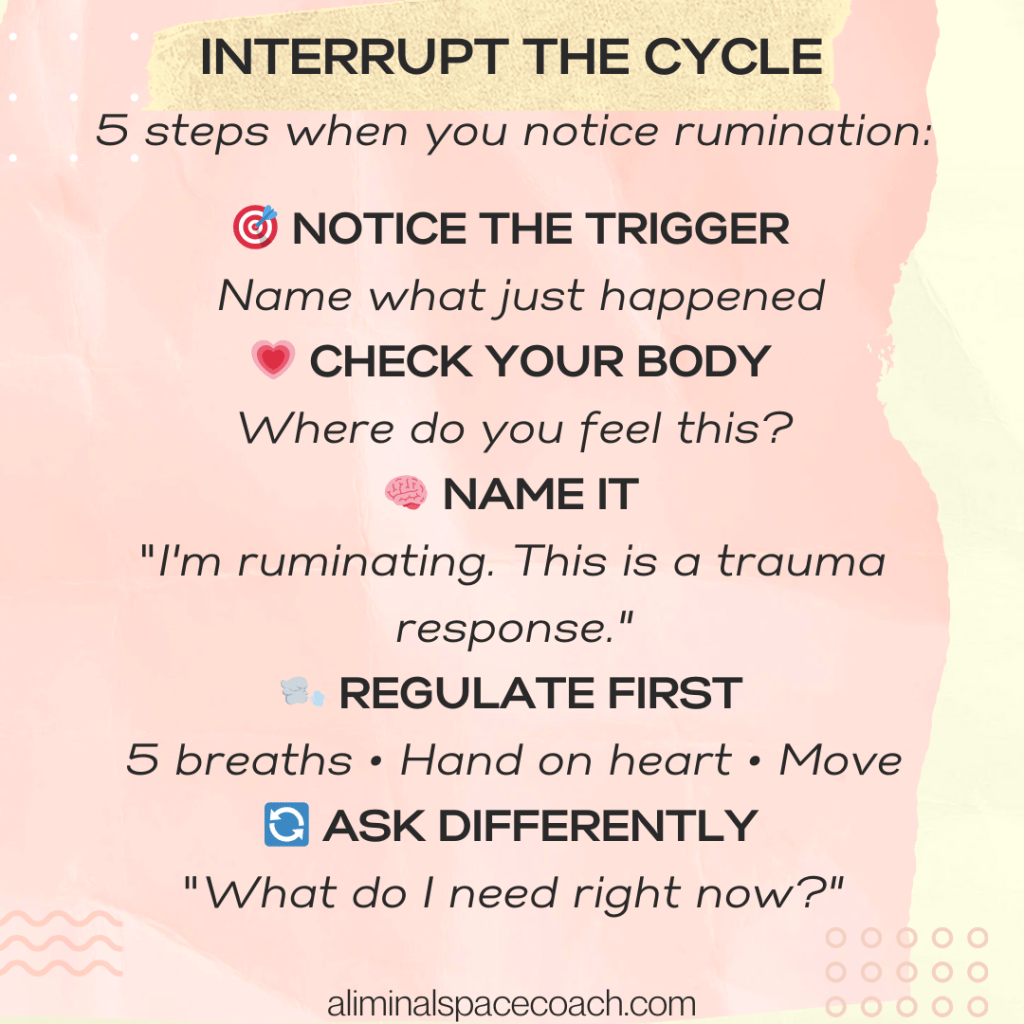
When you notice yourself starting to ruminate, try this:
1. Notice the trigger. What just happened that activated this pattern? Name it specifically: “I made a mistake at work” or “Someone didn’t respond to my text.”
2. Check your body. Where do you feel this in your body? Tight chest? Clenched jaw? Stomach churning? This is your nervous system signaling that you’re activated.
3. Name what’s happening. Say to yourself: “I’m ruminating. This is a trauma response. My mind is trying to keep me safe, but I’m not in danger right now.”
4. Regulate first. Before trying to figure anything out, do something that signals safety to your nervous system: Take five slow breaths. Put your hand on your heart. Step outside. Move your body. Drink cold water.
5. Ask a different question. Instead of “What’s wrong with me?” or “How do I fix this?” ask: “What do I need right now?” or “What’s one small thing I can do to take care of myself in this moment?”
The goal isn’t to solve the problem immediately. The goal is to interrupt the rumination cycle and return to the present moment where you have agency and choice.
For more information watch the entire Dr. K Healthy Gamer program: Why it Fells Like Everything is Wrong with You.
For information on understanding our nervous system, check out the work of Jan Winall “What is Felt Sense?”
If you’re recognizing rumination patterns in your own life and want peer support as you work through them, I’d be honored to walk alongside you. You can reach out to me at loriwilliamsliminalspace@gmail.com. I offer affordable support on a sliding fee scale.

 A Liminal Space
Leave a comment