
Does it ever feel like too much? I open social media and immediately feel overwhelmed. I miss the old Facebook—when my feed was just friends sharing life updates. Now I’m bombarded with headlines screaming that the world is on fire, democracy is crumbling, and I need to act now or be complicit.
My nervous system responds before my brain does. Should I share the post? Argue in the comments? Start researching how to move to Canada? By the time I’ve scrolled for five minutes, I’m either paralyzed with anxiety or fired up with rage—and neither one actually helps.
Then I talk to a family member who looks at me like I’ve lost my mind. To them, safety means holding onto what they’ve built here—home, family, careers that took decades to establish. We’re looking at the same situation and seeing completely different threats.
After a while, I start to feel powerless. And this is where it gets dangerous.
When Fear Becomes the Problem

I work in mental health, so I recognize what’s happening: so many of us are living in a constant state of threat activation. Our nervous systems are being hijacked by messaging designed to keep us alarmed, reactive, and scrolling.
Some of those alarms are legitimate. Real concerns deserve serious attention. But here’s what I’m noticing: the way we’re communicating about threats is making us less equipped to actually handle them.
Dr. Aimie Apigian, in her book The Biology of Trauma, explains that we need to understand trauma as something actively happening inside the body—not just as external events. When our bodies stay in survival mode, trauma-induced changes in our biology suppress our capacity for recovery. When we stay in survival mode, we lose access to:
- Clear thinking and strategy
- Meaning and purpose
- The ability to build coalition
- Energy for sustained action
This constant flood of alarming headlines isn’t just stressful—it’s actually disabling us. We become paralyzed, reactive, or so burned out that Netflix and doom-scrolling are all we have energy for. And people in survival mode don’t organize. They don’t show up. They don’t create change.
Viktor Frankl observed that during the worst times, the people who survived found meaning and purpose despite the suffering. But as my friend said in a book club recently: we need safety and calm to access meaning and purpose in the first place. And we can’t get there while we’re stuck in survival mode.
The Question That Matters
Here’s the real question: can we find safety without sticking our heads in the sand? How can we find meaning in a world that feels like it’s on fire without being in denial? Can we face actual threats without being paralyzed by them?
I know what denial looks like—I lived there for years, convincing myself certain leaders and systems would save us. When that illusion shattered, I had nothing to hold onto. Now I’d rather face a threat I can see clearly than one I’m constantly pretending isn’t there.
But I’m also done letting fear control everything I do.
What Actually Helps
This morning I met a neighbor for the first time. She told me how she makes decisions about her land based on respect for the people around her—because she wants peaceful relationships. Her property is full of wildflowers, honeybees, and bird houses. She’s working with nature and her community to help things thrive.
I have no idea who she voted for. It doesn’t matter. She understands that thriving requires working together.
That gave me more hope than any social media post ever has. Not outrage. Not fear. Just a real person doing real things that make the world slightly better.
A Different Kind of Movement
If you’re still reading, maybe you relate. Maybe you’re exhausted by the constant alarms. Maybe you want to contribute something besides fear.
Here’s what I’m learning as a trauma survivor and mental health practitioner: our goal should always be to mobilize people towards healthy choices, not paralyze them with fear.
Fear gets attention for about 30 seconds. But if we keep people afraid without giving them agency, we get:
- Learned helplessness
- Avoidance and numbing
- Burnout and dropout from movements that need them
- Poor decision-making instead of strategy
Real motivation comes from:
- Clarity on what to do (not just what’s wrong)
- Evidence that action matters (stories of wins, not just doom)
- Connection to others (we’re in this together)
- Hope that’s earned through real work, not empty reassurance
How to Shift What We’re Putting Out There
Before you share that alarming post, ask yourself: Is this helping people understand what to DO, or just making them more afraid?
Because scared, paralyzed people don’t organize. They don’t show up. They don’t protect vulnerable people. They doom-scroll and despair.
Motivated people do.
So here’s what I’m trying:
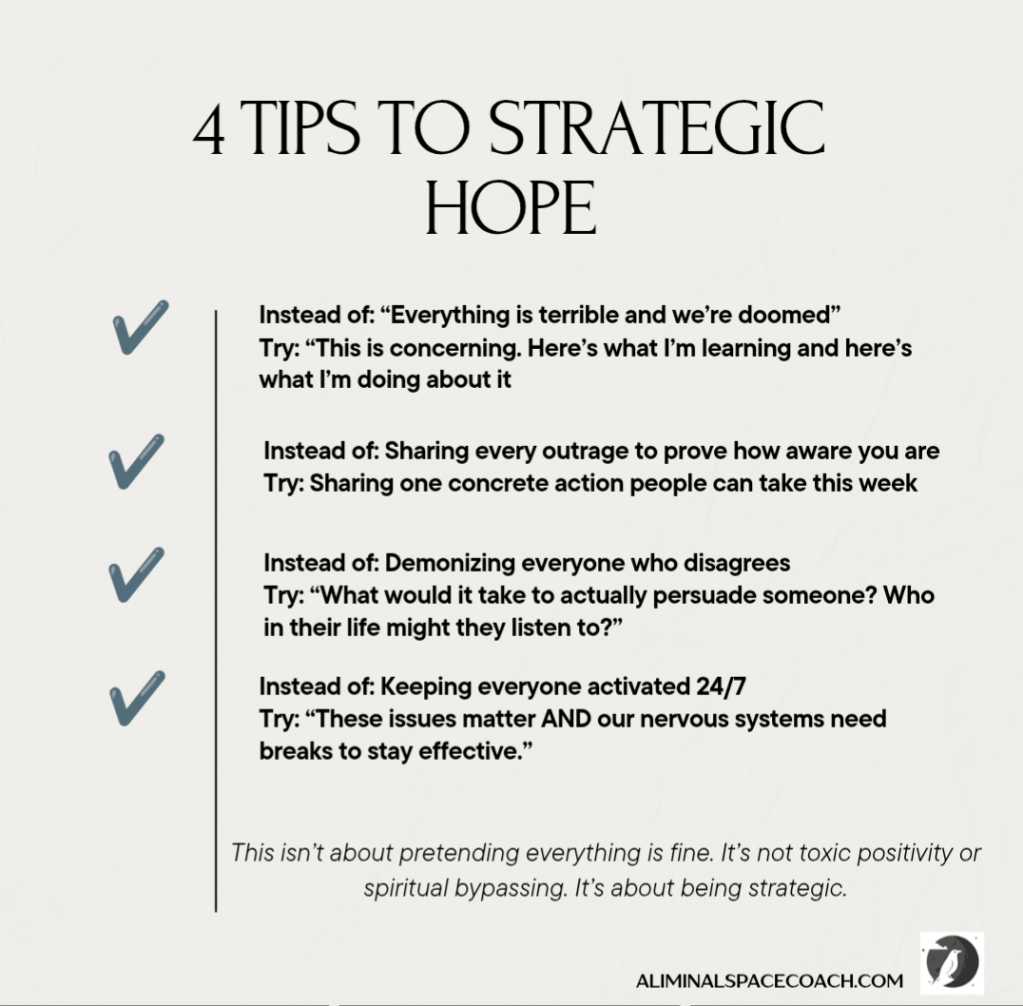
Instead of: “Everything is terrible and we’re doomed”
Try: “This is concerning. Here’s what I’m learning and here’s what I’m doing about it.”
Instead of: Sharing every outrage to prove how aware you are
Try: Sharing one concrete action people can take this week
Instead of: Demonizing everyone who disagrees
Try: “What would it take to actually persuade someone? Who in their life might they listen to?”
Instead of: Keeping everyone activated 24/7
Try: “These issues matter AND our nervous systems need breaks to stay effective.”
This isn’t about pretending everything is fine. It’s not toxic positivity or spiritual bypassing. It’s about being strategic.
Both things can be true: Real threats exist AND the way we’re responding to them is making us weaker, not stronger.
Finding Your Anchor: Practices for Meaning and Purpose
I’m starting to notice how much space the anger and fear are taking up in me. How much energy doom-scrolling requires. How little is left for actually thriving—or helping others thrive.
So I’m looking for anchors. Things that keep me grounded when everything feels chaotic.
1. Discover Your Dharma (Your Responsibility)
Dr. Alok Kanojia (Dr. K from HealthyGamerGG) teaches about the concept of dharma—a Sanskrit word meaning duty or responsibility. Dharma is what allows you to choose the path of pain and face adversity without relying solely on willpower. It’s finding the thing that gives your life such meaning that you’re willing to endure difficulty for it.
Practice: Make two lists:
- What do you want? (desires – money, status, comfort)
- What do you care about? (values – justice, community, creativity, protection of vulnerable people)
Cross out everything rooted purely in desires. Look for things you could endure pain for—those are rooted in your values. Your dharma might be your family, a cause that needs you, creative work that matters, or something only you can contribute based on your unique experiences.
2. Turn Experience Into Purpose
Your struggles aren’t wasted—they’re preparation. Every human being has a unique draw toward a certain direction, and this gravity enables people to endure the necessary struggle that brings them toward meaning, peace, and satisfaction.
Practice: Reflect on what you’ve been through. What have your challenges taught you? Who could benefit from your hard-won wisdom? Your dharma often appears at the intersection of your experiences and what the world needs from you.
3. Start Where You Are
You don’t need a grand purpose to start. Begin with small, concrete actions:
- Local involvement: Join a neighborhood group, volunteer at a local organization, show up to city council meetings
- Direct support: Help a specific person or family in need
- Skill-sharing: Teach something you know to someone who wants to learn
- Community building: Host a gathering, start a book club, create spaces for connection
4. Practice Nervous System Regulation
Dr. Apigian emphasizes that healing requires working with your nervous system to prevent trauma-induced changes that suppress recovery. You can’t find meaning when you’re stuck in fight-or-flight.
Daily practices:
- Morning: 5-10 minutes of movement (walk, stretch, dance)
- Throughout the day: Deep breathing when you notice tension
- Evening: Reflect on one thing you contributed today (however small)
- Weekly: One activity in nature, one face-to-face conversation with someone who energizes you
5. The “What Can I Influence?” Inventory
Focus 80% of your energy on the last two columns.
Make three columns:
- Can’t control: National politics, other people’s choices, the news cycle
- Can influence: Conversations with people I know, my local community, my own actions
- Can fully control: My information consumption, my nervous system care, where I put my energy
The Movement Forward
The lighthouse through the fog isn’t another alarm. It’s people doing the work—building community, protecting vulnerable people, organizing strategically, and refusing to let fear be the only story.
That’s the movement I want to be part of. Not one that spreads fear, but one that spreads capacity.
If you’re tired of the noise and ready to build something steadier, you’re not alone. Start with finding safety within yourself. Then share that peace outward.
Because the world doesn’t need more people screaming into the void. It needs more people planting wildflowers and working with their neighbors—no matter who they voted for.
That’s how things actually change.
Resources:
- The Biology of Trauma by Dr. Aimie Apigian (with foreword by Dr. Gabor Maté)
- HealthyGamerGG on YouTube: “Dr. K talks Meaning, Purpose, and Motivation” and “Why You Should Follow Your Dharma”

 A Liminal Space
Leave a comment