
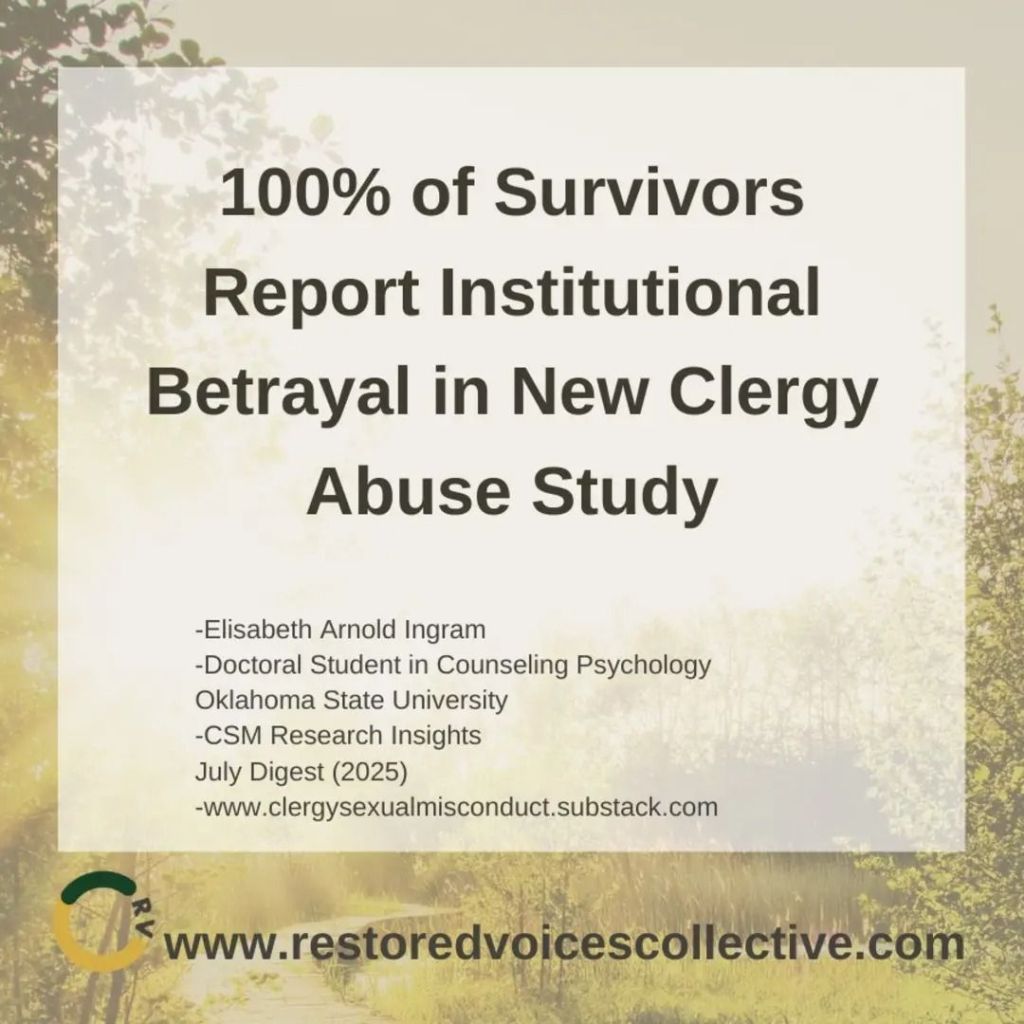
That statistic doesn’t surprise me. I lived it too. But I’ve spent so much time since then wondering why this keeps happening. When you’re a survivor and hardly anyone believes you, it becomes almost impossible not to question yourself. Even with a therapist saying over and over “this isn’t your fault,” even with the friends and family who stuck around telling you the same thing, that part of me that was wired to believe I needed the church’s approval to be good kept pulling me back toward them like some fierce undertow. Thank God there were enough people speaking truth to keep me from drowning in that current.
I’ve wondered endlessly since then: why is it so hard to believe that a pastor can harm someone in their care? Why is it so hard to believe that someone who claims to love God would do something like this? I know we can’t always have answers, but I think those of us who’ve survived this kind of abuse need to understand some of the reasons why—so we don’t turn the blame back on ourselves.
The Weight of What We Stand to Lose
Like my friend and I were talking about yesterday, people identify with the leaders they follow. There’s a reason we follow them. Many of those reasons connect to our own values, the things that matter to us, the things we’re afraid of losing, the hopes we cling to, the community we call our people. When you really think about everything a person stands to lose, there are so many reasons why survivors aren’t believed. It’s so much easier to blame one person or chalk it up to human error than risk losing everything you hold dear.
That’s actually why I stayed so long. I didn’t think there was anywhere else to go. How could I risk losing so much? It was only when I realized that what I was holding onto wasn’t at all what I thought it was—when I finally fell hard and hit bottom—that I could see the foundation holding me up was built on sinking sand. Today, I’m grateful I finally hit the bottom of a system that was never built on the rock it claimed to be built on.
How do I know? Because a real family protects its own. They’re willing to do the work to figure out why something happened, not just settle for an easy answer that brings temporary relief from the pain. In my case, they said the matter would no longer be discussed. They wanted it to disappear because they realized if it didn’t, people might start asking questions and getting confused.
The Familiar Pattern of Taking Blame
There were so many ways to justify their decisions. Just like there were so many reasons for me to justify staying in the abuse. I’ll admit I stayed because I was scared there wasn’t anything else out there for me. Looking back, I realize my time in that religious system was a lot like my time in my own broken family system. I learned as a child to take all the blame for what was wrong, because if I took the blame, at least I had some control. As a child in a broken system, if my parents were to blame, it meant there was no control at all.
It was the same thing in the church. But when I realized what happened wasn’t actually my fault—that it was way bigger than that—I didn’t know what else to do except let go and fall into the darkness of the unknown.
Finding Real Treasure in the Darkness

I’ve learned, looking up from the bottom, to look for the things worth holding onto. They aren’t glaringly obvious. It actually takes time digging around in the darkness to find the treasures in the field. But Jesus said that once we find that treasure, we’ll sell everything we have to purchase that field. I had to let go of the fool’s gold to be able to dig and find the real thing. And letting go was the hardest part.
Letting go of the false security that I actually had control in a system that told me what to believe. Letting go of the people I’d put on pedestals, the people I’d convinced myself would take care of me. Letting go of the notion that they were going to save me. Letting go of the family I thought would love me unconditionally. Letting go of all my expectations of what life was supposed to be like.
It’s not easy work at all, and it took everything blowing up for me to see the truth and let go. So if I really think about it, I can understand why the church doesn’t protect one survivor of abuse. It’s better to lose one person than a whole system, right? Or is it? It just depends on whether that system is worth holding onto. I guess the big question is: would it protect you under the same circumstances?
The Canary in the Coal Mine
These days I think of myself as the canary that came out of the coal mine, alerting others that there was something toxic. When one member suffers, all suffer. The same is true for families. When one member suffers, all suffer—if we really care about each other. Love shows up and takes action when someone they love is hurting.
We all have choices in life. Thankfully, we have lots of opportunities to correct bad choices too. But when we’re not willing to look at the fallout of bad choices and learn, we keep repeating the same things.
When I see someone I care about hurting these days, I remember how lonely it was when I hit rock bottom. I remember how much it hurt seeing all the wreckage around me and wanting someone else to come alongside and tell me it wasn’t all my fault. And thankfully those people came and stayed and got dirty alongside me, helping me pick up the broken pieces. Because that’s what love does. Maybe some people haven’t had the opportunity to experience this kind of love, and that’s why they choose the system over the person.
The Choice That Changed Everything
Recently, I was with someone who said that if a person was an adult, they made a conscious choice and can’t just say they were abused. That comment felt like a kick in the gut. But I’ve learned to pay attention when something hurts like that and use it as an opportunity to dig deeper into why it hurt.
It’s true—I made a choice. A choice to trust a person who I believed had my best interests at heart. A person I looked up to who taught me things about God that filled my soul with hope. A person who made me feel safe enough to tell my story to, hoping he would help me heal and honor God moving forward. A choice to believe that the advice he was giving me was right. A choice to believe that men were in a higher position of authority above me. A choice to believe that when he said he loved me, he meant it. A choice to trust his guidance for my life when he told me I had caused him to desire me in ways he shouldn’t—three months after I trusted him with the deepest, darkest secrets of my life.
Yes, I made a choice. And once I made that choice, I’d invested everything, and it felt like there was too much to lose if I told the truth. A choice that placed me in a prison of shame I didn’t think I’d ever escape. And I was responsible for that choice. I take responsibility for it. A choice that led to so much harm I lost my own identity.
But when it all fell apart, I had another choice to make: continue holding onto all the lies I’d believed, or let go and find something true and real to hold onto. And that’s what I did.
Choose Wisely
So I choose wisely these days. I don’t just settle for what people are telling me. I dig deep. Because you deserve better than a system that chooses a false narrative over love.
—
*If you’re a survivor reading this, know that you’re not alone. Your story matters. Your voice matters. And it’s never too late to choose something better.*

 A Liminal Space
Leave a comment